Legal Tender
Legal Tender
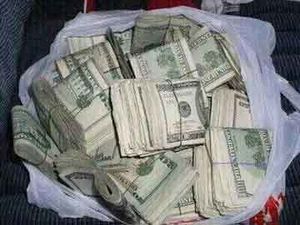
Not Real Money but is only legal tender which does not pay debt but only discharges it[1] because it involves a third party.
Federal Reserve was allowing the creation of debt that would lead to confiscation of gold owned by "Persons".
“The privilege of creating and issuing money is not only the supreme prerogative of Government, but it is the Government's greatest creative opportunity. By the adoption of these principles, the long-felt want for a uniform medium will be satisfied. The taxpayers will be saved immense sums of interest, discounts and exchanges. The financing of all public enterprises, the maintenance of stable government and ordered progress, and the conduct of the Treasury will become matters of practical administration. The people can and will be furnished with a currency as safe as their own government. Money will cease to be the master and become the servant of humanity. Democracy will rise superior to the money power.” -President Abraham Lincoln, signed the Legal Tender Act, allowing paper money.
We call notes, dollars and think they have value.
When we see bundles of them we think we are rich.
We call them money.
Of course a NOTE was not a DOLLAR.
A note is at best a promise to pay.
A note represents debt.
A note is not real money.
First, there is a serious lack of real capital since the creation of the Federal Reserve by socialists and communists like Edward Mandell House. You cannot pay a debt with a note.[1] Legal Tender is not the same as lawful money and cannot purchase a lawful title. Reducing all ownership to a legal title produced the death of true capitalism.
With the loss of just weights and measures the potential of true capitalism was lost. What the people were left with was pseudo-capitalism.[2]
The pervasiveness of a mere legal title through the discharge of debt with notes capitalism is further undermined. But when the masses develop an appetitefor benefits through the covetous practices of the socialist system of social welfare through exercising authority of theState the people have lost the moral compass required for the pure application of true capitalism through the "perfect law of liberty".
I tried to explain to the fellow who thinks that "Money can be anything":
The only lawful money is money of "present value" which means "commodity money".
Once a value is imposed by stamp or imprint resulting from arbitrary determination then the money is not lawful. It may be legal tender but legal tender is not lawful money.[1]
Federal Reserve notes have two stamps because they are three party notes.
Temples, Banks and the Brokerage House.
The reference to a temple as a bank is not uncommon. The temples in Egypt acted much like banks, issuing script, coining forms of usurious money, making loans and collecting interest, especially during times when the people were in bondage and the gold and silver was in the treasury, not in their own purse. People used substitutes or legal tender instead of lawful money. These temples in ancient times could act as investment houses for mining, trade and even military ventures. Great returns could be had with such investments in temples like Janus and Diana.
Most of the power exercised by government over the people today, especially the Federal government, is based on contracts or compacts between the government and the people. Not understanding the contractual nature of governments and the power of the Contract clause[3] in the constitution might lead many to think that the government is usurping its powers.
Paul McGuire talks about the Mark of the Beast which he sees as an electronic micro or bio chip or tattoo. He also talks about the movement toward a cashless society from Sweden to the United States. McGuire writes about The Coming Cashless Society: Big Brother & The Mark of the Beast.
The truth is according to the original definition of the word "cash" we already live in a cashless society and have for decades.
John Law was born into a family of bankers and goldsmiths from Fife and baptized on the 21 April 1671. By the early 1700's he urged the establishment of a national bank to create and increase "instruments of credit and the issue of banknotes" backed by land, gold, or silver. Over the following two centuries there were numerous banks that failed and their notes became worthless. These notes were eventually called "legal tender" and were considered of value as long as they were redeemable in "lawful money" such as gold and silver coin which was considered cash. Cash in the mid 1800's was still defined as gold, silver or even copper coin. All bank notes were rejected as not being cash in any establishment who had a cash-only policy. Somewhere in our history the definition of the word "cash" was gradually redefined to include "notes".
Many talk about the Mark of the Beast being a part of a one-world political, economic and religious system that is coming and they see these news items as foreshadowing the coming fulfillment of the prophecies of Revelation. If the changing of the meaning of the word cash to include notes can fool us into thinking that we do not already live in a cashless society then how much more can we be fooled by changing the meaning of words like “religion”.
Religion used to mean the performance of your duty to God and your fellow man but now it is just whatever you think about a supreme being. There are two ways to practice and perform our duty to our fellow man.
We can fulfill that duty to our fellow man by charity or we can do it by force. John the Baptist and Christ said to use charity and not be like the governments of the gentiles who used force. James went so far as to explain that the practice of pure religion did not depend on anything spotted by the “world”. That "world" he spoke of was the constitutional order of Rome or any government like Rome where the leaders call themselves benefactors but only provide those benefits by taking from our neighbor through their exercising authority.[4]
- ↑ 1.0 1.1 1.2 Just payment
- Leviticus 19:36 Just balances, just weights, a just ephah, and a just hin, shall ye have: I [am] the LORD your God, which brought you out of the land of Egypt.
- "Money is the just medium and measure of all commutable things, for, by the medium of money, a convenient and just estimation of all things is made."?
Maxim: "Moneta est justum medium et mensura rerum commutabilium, nam per meduim monetae fit omnium rerum conveniens, et justa aestimatio." Dav. 18. See 1 Bouv. Inst. n. 922. - "There is a distinction between a `debt discharged' and a `debt paid.' When discharged the debt still exists though divested of its character as a legal obligation during the operation of the discharge. Something of the original vitality of the debt continues to exist, which may be transferred, even though the transferee takes it subject to its disability incident to the discharge. The fact that it carries something which may be a consideration for a new promise to pay, so as to make an otherwise worthless promise a legal obligation, makes it the subject of transfer by assignment." Stanek v. White. 172 Minn. 390, 215 N. W. 784.
- "Thus, it is clear that, as a result of HJR 192 and from that day forward (June 5, 1933), no one has been able to pay a debt. The only thing they can do is tender in transfer of debts, and the debt is perpetual." Understanding the Impact of HJR-192: Suspension of the Gold.
- While these terms are used interchangeably, "lawful money" has a broader meaning than "legal tender".
- ↑ "Pseudo-capitalism" refers to an economic system that superficially resembles capitalism but deviates from its core principles by favoring political connections and influence over free market competition, often leading to cronyism and inequality.
- ↑ Contract Clause of the United States Constitution, Article I, section 10, clause 1.
It states:
- No State shall enter into any Treaty, Alliance, or Confederation; grant Letters of Marque and Reprisal; coin Money; emit Bills of Credit; make any Thing but gold and silver Coin a Tender in Payment of Debts; pass any Bill of Attainder, ex post facto Law, or Law impairing the Obligation of Contracts, or grant any Title of Nobility.
- ↑ Not exercise authority
- Matthew 20:25 "But Jesus called them unto him, and said, Ye know that the princes of the Gentiles exercise dominion over them, and they that are great exercise authority upon them. But it shall not be so among you:..."
- Mark 10:42 "But Jesus called them to him, and saith unto them, Ye know that they which are accounted to rule over the Gentiles exercise lordship over them; and their great ones exercise authority upon them. But so shall it not be among you:..."
- Luke 22:25 "And he said unto them, The kings of the Gentiles exercise lordship over them; and they that exercise authority upon them are called benefactors. But ye [shall] not [be] so:..."